Before the Sticky Note: The Index Card as a Thinking Tool
Use an index card thinking tool to turn scattered idea fragments into a clear concept map, then choose which relationships deserve space in your draft.
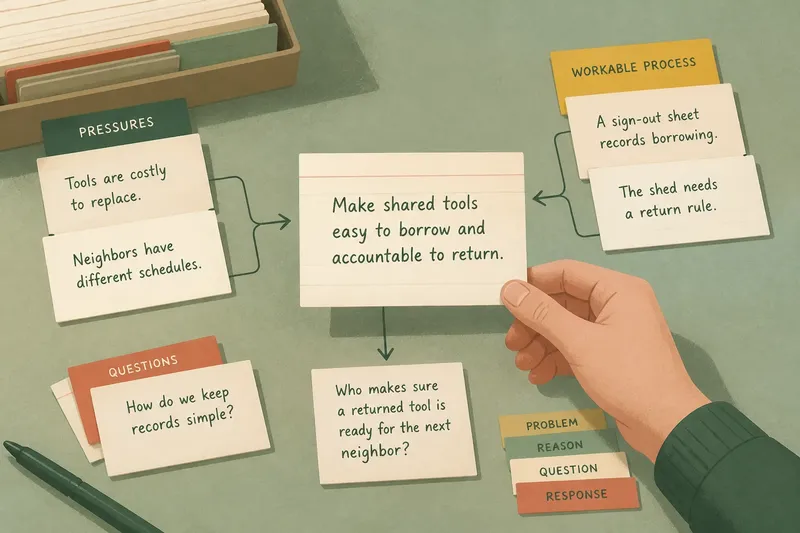
How do you turn scattered notes into a concept you can explain? An index card thinking tool lets you separate claims, examples, and questions so you can see how they might work together. Instead of treating the cards as a miniature outline, use them to decide what the idea is actually about.
What belongs on an index card?
Write one thought that can be considered on its own: a claim, a reason, a question, an example, or a decision. Use an index card, sturdy scrap paper, or movable notes in an app such as Miro or Apple Notes. The important feature is that each thought can be moved without carrying unrelated material with it.
Make the thought clear enough to understand outside your notebook. “People abandon the form when the next action is unclear” can stand alone; “unclear next” cannot. If a card contains a claim and several reasons, split it. You can later decide whether the parts form one concept or point toward different ones.
Add a brief label only when it helps distinguish the card’s role. “Problem,” “reason,” and “possible response” are useful labels; decorative color codes often add little. If you use colored cards, assign each color a specific meaning and keep that meaning consistent.
How can cards help you shape a concept?
Choose a question you want the idea to answer, then put only relevant thoughts on the table or digital canvas. Look for a relationship that could become the concept’s central claim. A useful concept is more than a pile of related subjects: it gives the reader a reason to see those subjects together.
Try arranging cards by the relationship they express, not just by topic. One group might describe a problem and its cause; another might suggest a response and explain why it fits. A card that seems to belong in several places may contain two separate thoughts, or it may point to a broader idea that can connect the groups.
Say you are shaping an explanation for a community garden’s tool-sharing system. Your starting cards say “tools are costly to replace,” “neighbors have different schedules,” “a sign-out sheet records borrowing,” and “the shed needs a return rule.” You group the first two as pressures on shared access and the last two as parts of a workable process. The resulting concept is not simply “share tools”; it is “make shared tools easy to borrow and accountable to return.” That claim gives the explanation a focus, while leaving you to decide which details actually support it.
How do you tell a useful connection from a loose association?
Ask what one card helps you understand about another. A connection is useful when you can state its logic plainly: one card gives a reason, consequence, contrast, or example for the other. If the only explanation is that both cards concern the same subject, they may belong in separate parts of the work.
Write a short connector card when the relationship is not yet clear. For the garden idea, “Who makes sure a returned tool is ready for the next neighbor?” could link the sign-out sheet to the return rule. If you cannot answer the question from the material you have, keep the groups apart rather than inventing a connection.
- Observation: Two cards make the same claim in different words. If neither adds a distinct reason or example, then combine them; otherwise keep both and note the different job each does.
- Observation: One card contains a claim and a separate example. If either thought could support a different point, then split the card; otherwise retain them together as one claim-example unit.
- Observation: A group shares a topic but has no stated relationship. If you can write a connector that explains cause, contrast, or support, then add it; otherwise separate the group or gather more material.
- Observation: One card seems to fit several groups. If it contains multiple thoughts, then split it; otherwise mark it as a possible link and decide which group needs it most.
- Observation: A sequence changes the meaning of the central claim. If the changed emphasis suits the intended reader, then keep that sequence; otherwise restore the earlier order and test another arrangement.
- Observation: A reader asks the same clarifying question at a particular transition. If the draft lacks the answer, then add an explanatory card or sentence; otherwise revise the wording of the card that caused confusion.
Which sequence makes the concept easiest to grasp?
Try a small number of different openings rather than polishing one order too soon. You might lead with the reader’s problem, the concept’s central claim, or a concrete process that reveals why the claim matters. Each choice gives the same material a different emphasis.
Read the cards in sequence and state the link between each pair aloud. Does the next card answer a question, give a reason, or offer an example? If the connection exists only in your head, mark the transition. In the draft, you may need a sentence that makes the logic visible.
For the garden concept, one sequence could begin with the difficulty of replacing tools, introduce the sign-out sheet, then explain the return rule. Another could follow a neighbor borrowing a tool, show how the record makes the borrowing visible, and explain how the return rule supports the next person. The first emphasizes stewardship; the second emphasizes the user’s experience. Choose the order that best expresses the concept you want readers to understand.
How can feedback sharpen the concept?
Show a reader the central claim and the card groups before asking for a general opinion. Give them a focused task: ask which card does not support the claim, where the logic skips a step, or what the concept seems to promise. Their answer can help you distinguish a weak connection from a concept that needs a narrower focus.
Record comments separately from the cards that state your own ideas. Then decide what kind of change the comment calls for. You might clarify a card, change the central claim, move an example, or leave the arrangement alone because the reader has a different purpose in mind.
Imagine a reader looks at the garden cards and asks whether the system is meant to prevent missing tools or help neighbors find them. That question exposes two possible concepts. You could narrow the claim to accountability and revise the supporting cards, or broaden it to explain how the process supports both tracking and access. The choice depends on which purpose the available material can explain clearly.
What should you know about using index cards?
How many thoughts belong on one index card?
Use one independently movable thought per card. Split a card when its parts could support different claims or belong in different groups.
Should the cards already be in presentation order?
No. Capture the thoughts in whatever order they occur, then arrange them to test what concept they support and what emphasis a sequence creates.
What should I do with repeated cards?
Compare what each version contributes before combining them. Keep distinct reasons or examples separate, but merge cards that make the same point without adding a new purpose.
Can I use a digital board instead of paper cards?
Yes. Miro, Apple Notes, or another app works if you can move individual notes freely and see the groups at once. Choose paper if handling and rearranging cards helps you compare ideas; choose a digital board if you need to share or search the material.
When is the concept ready to draft?
Start when you can state the concept in a sentence, identify which cards support it, and explain why the main groups belong together. That does not mean every transition is solved. It means you know what the work is trying to say and can see where the reader will need an explanation.
Draft a paragraph from one group, then check whether it still serves the central claim. If a detail pulls the paragraph toward another concept, move it aside or revise the claim. The index card thinking tool has done its job when it helps you choose what the idea means—not when every card has a permanent place.