A Short Brief or an Open Page? Choosing a Starting Constraint
Choose a starting constraint that fits the work: use a short brief to focus a defined task, or an open page to explore an idea that is still unclear.
Should you start with a short brief or an open page? Choosing a starting constraint depends on what the work needs next: a brief can clarify a known assignment, while an open page can help you decide what the assignment should become.
These are different tools, not competing creative philosophies. A brief organizes decisions around a stated purpose. An open page gives you room to examine material without having to defend a direction too soon.
What does a short brief help you decide?
A short brief records the decisions that are already firm enough to guide the work. It can name the intended reader, the purpose, the format, and any essential content. It should leave the means of achieving that purpose open.
For example, “Help new volunteers understand how a neighborhood garden shares tools, using a one-page handout” gives a writer a reader, goal, and form. It does not decide the order of information, the tone, or the visual layout. Those remain choices to make as the work develops.
Use a brief when the assignment is stable enough that you can judge options against it. If the goal is unclear, writing a polished brief can hide the uncertainty rather than resolve it. State what is known, and mark assumptions as assumptions.
What should you put on an open page?
An open page is a place to sort material, not a promise to keep every possibility alive. Write down observations, questions, tensions, or competing interpretations. Keep each note concrete enough that you can tell what it refers to later.
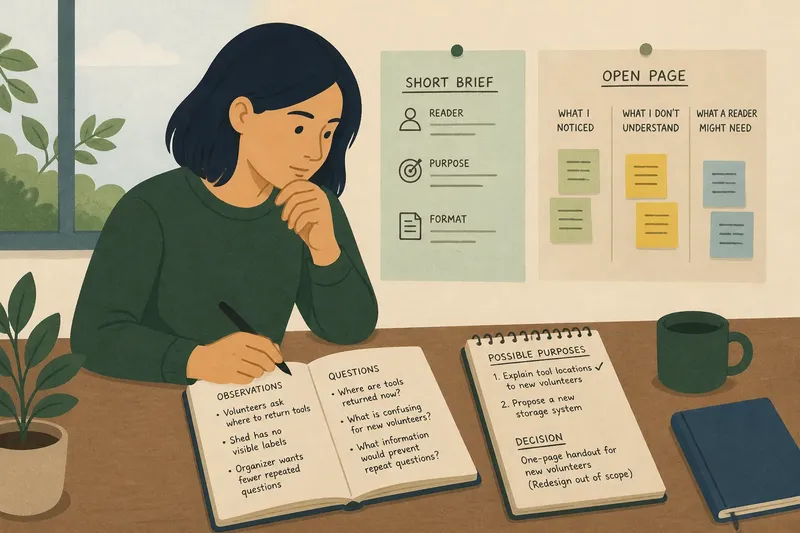
A useful open page might have three simple areas: what you noticed, what you do not yet understand, and what a reader might need. A paper notebook works well; a document in Google Docs or a board in Miro can help if you need to rearrange notes. The tool matters less than keeping raw observations distinct from conclusions.
Do not turn the page into a list of abstract themes alone. “Community” is hard to evaluate; “volunteers leave before learning where shared tools go” points to a specific friction. Concrete notes make it easier to see which questions deserve development.
How can you choose a starting constraint?
Look at the decisions you can make responsibly now. If the reader and intended outcome are clear, set those as boundaries. If you are still deciding what the material means or who needs it, record what is uncertain instead of pretending the brief is settled.
- The purpose is settled: Check that you can state what the work should help someone understand or do. If you can, put that purpose in a brief; if not, list the competing purposes on an open page.
- The intended reader is named: Check whether you can describe what that reader already knows. If you can, use the reader to guide explanations; if not, note the possible readers and what differs between them.
- Several directions fit the material: Check whether each direction answers a distinct question. If they do, record them side by side before choosing; if they do not, combine overlapping options into one clearer question.
- The format is assigned: Check whether it serves the stated purpose. If it does, include it in the brief; if it blocks the purpose, flag the conflict and ask whoever owns the assignment to clarify.
- A prompt feels restrictive: Check which requirement causes the problem and why. If it protects a real audience need, keep it; if it rests on an untested assumption, mark that assumption and explore an alternative.
- You keep returning to one question: Check whether the question is specific enough to guide a draft. If it is, use it as the brief’s central task; if it is too broad, narrow it to a reader, situation, or decision.
Say you have three invented notes from a garden meeting: volunteers ask where to return tools, the shed has no visible labels, and the organizer wants fewer repeated questions. First, keep those observations separate from a conclusion about why they happen. Next, compare two possible purposes: explain tool locations or propose a new storage system. Since the notes directly support the first purpose but do not establish what storage changes are feasible, choose a one-page handout for new volunteers and leave redesign out of scope. The resulting brief names the reader, purpose, and format while preserving a clear limit on what the notes can support.
What if the brief or open page stops helping?
When a brief creates confusion, inspect its boundaries one at a time. A format may be fixed while the reader remains uncertain; a reader may be settled while the desired action is vague. Keep the parts that are known and write a question beside each unresolved part.
If an open page keeps accumulating notes without producing a decision, sort the material by the question each note might answer. A cluster with no clear connection may need more observation. A cluster that points to one reader problem may support a draft brief. Neither result requires you to treat an early interpretation as final.
Make changes visible. In a shared Google Doc, mark a revised purpose with a comment or a brief note explaining what changed. That gives collaborators a chance to respond to the actual decision rather than an outdated version of the task.
Which starting constraint fits your task?
Is a brief different from a prompt?
A brief usually states practical boundaries such as purpose, reader, and format. A prompt may simply offer a subject or question, leaving the intended outcome open.
Can a brief leave some decisions open?
Yes. A useful brief records only the boundaries that matter now. Leaving tone, structure, or visual treatment undecided can preserve room for the work to respond to its material.
What should you do if you have several possible readers?
Write down what each reader needs to understand or decide, then compare those needs with the available material. If the needs differ substantially, treat them as separate possible tasks rather than squeezing them into one vague brief.
When should you stop sorting notes?
Move toward a brief when you can name a reader, a purpose, and a plausible next form without relying on an assumption you have not checked. If one of those remains unsettled, identify the missing information or decision before drafting as if it were settled.
How do you keep the starting choice useful?
Choose the form that makes the next decision visible. A brief is useful when it lets you compare ways to meet a known purpose. An open page is useful when you need to distinguish observations from interpretations before deciding what the work should do.
For the search phrase short brief or open page, the practical distinction is not which method is more creative; it is which one makes the unresolved decision easier to see. Name that decision in your notes, and the next move—clarify the brief, gather more material, or draft a focused piece—will be easier to justify.